
Look inside any wardrobe across the globe and you’ll find it — draped on a hanger, folded in a drawer, or thrown over a chair. The T-shirt is the great sartorial equalizer, transcending generations, professions, and cultures. Billions are produced and shipped worldwide every single year. Yet despite its universal presence, one simple question almost nobody can answer is: what does the “T” in T-shirt actually mean?
The answer lies at the intersection of geometry, industrial efficiency, and over a century of textile engineering.
The Simple Geometric Reason Behind the Name
To understand the name, stop thinking about the T-shirt as a piece of clothing and start thinking about it as a pattern cut on the factory floor.
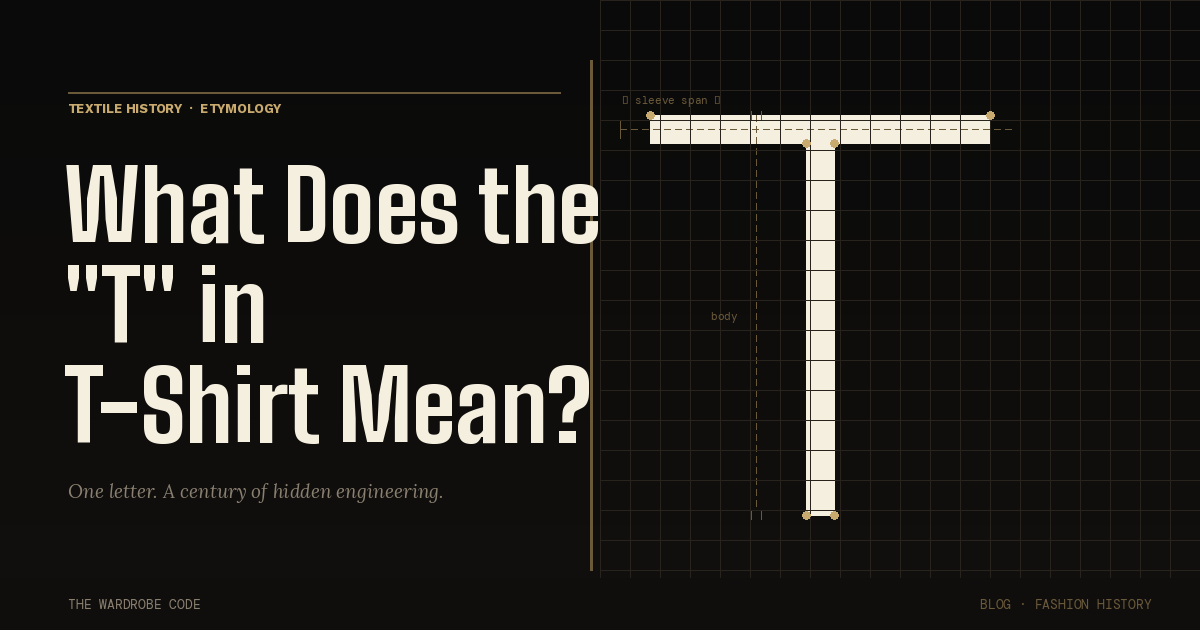
When a classic T-shirt is laid completely flat with its sleeves extended horizontally, the silhouette forms a perfect, capital letter “T” — and that’s exactly where the name comes from.
It’s not an acronym. It’s not named after a person or brand. It’s pure, functional geometry.
In the world of pattern drafting, the “T” shape represents peak production efficiency. Clean, straight lines maximise fabric yield and minimise cutting waste. The vertical trunk forms the body; the horizontal crossbar creates the sleeves. Historically, seamless circular knitting machines produced a tube of fabric for the body, requiring only sleeve panels and a reinforced collar to be added. This elegant structural simplicity earned the garment its alphabetical name — one that has endured for over a century.
From Union Suits to the “Bachelor Undershirt”: The T-Shirt’s Unexpected Origins
The T-shirt was not born on a catwalk. It was born out of necessity in the sweltering heat of industrial workplaces.
In the late 19th and early 20th centuries, the standard undergarment was the “union suit” — a heavy, restrictive, one-piece woollen garment that covered the entire body. Labourers working in factories and boiler rooms routinely cut their union suits in half just to survive the heat, inadvertently inventing a two-piece alternative.
Spotting this shift, the Cooper Underwear Company made a pivotal move in 1904, introducing a crew-neck, short-sleeved top they marketed as the “bachelor undershirt.” The genius of the campaign was in its simplicity: the garment required “no safety pins, no buttons, no needle, no thread.” It was marketed directly at unmarried men who lacked the sewing skills — or a partner — to repair lost buttons.
Then came the military seal of approval.
In 1913, the United States Navy officially adopted the T-shaped design as standard issue — lightweight, highly absorbent white cotton engineered to protect expensive naval uniforms from sweat while giving sailors full freedom of movement on deck. It was purely functional, but its mass adoption set the stage for everything that followed.
When Did the Word “T-Shirt” First Appear?
The garment existed long before the word did.
Linguistic credit for coining “T-shirt” in print goes to none other than F. Scott Fitzgerald, who included the word in his 1920 novel This Side of Paradise — making it the first recorded use of the term in published English literature. That single appearance officially moved the geometric, technical descriptor into the mainstream language.
Quick fact: “T-shirt” is one of the few clothing terms named directly after the shape of the garment itself, rather than its function, origin, or material.
How Hollywood Transformed the T-Shirt from Underwear to Icon
For decades after Fitzgerald’s novel, the T-shirt remained firmly an undergarment — worn beneath dress shirts, never seen in public.
That changed dramatically in the 1950s, when two Hollywood actors rewrote the cultural rules entirely.
When Marlon Brando wore a plain white T-shirt in A Streetcar Named Desire (1951) and James Dean made it the uniform of cool rebellion in Rebel Without a Cause (1955), public demand for the T-shirt as standalone outerwear exploded overnight.
But this cultural shift required genuine structural re-engineering:
- Fabric weight increased from sheer, lightweight 3-ounce undergarment weaves to dense, durable 5–6 ounce ringspun cottons capable of surviving as outer layers.
- Necklines were redesigned with high-tension ribbing to prevent stretching out of shape.
- Taped shoulder seams were introduced to withstand rigorous, repeated washing and wear.
What had been engineered for invisibility now had to be engineered for visibility — and durability.
The T-Shirt as a Modern Engineering Canvas
Today, that iconic “T” silhouette serves as the most widely used decorative canvas in the world.
Its flat, unadorned chest panel is precision-optimised for:
- Commercial screen-printing — the flat surface allows consistent ink pressure and clean registration across millions of units.
- Direct-to-garment (DTG) digital printing — the dense cotton weave absorbs pigment evenly for photographic-quality results.
- Embroidery and heat-transfer applications — the structured tension across the chest provides a stable, wrinkle-resistant surface.
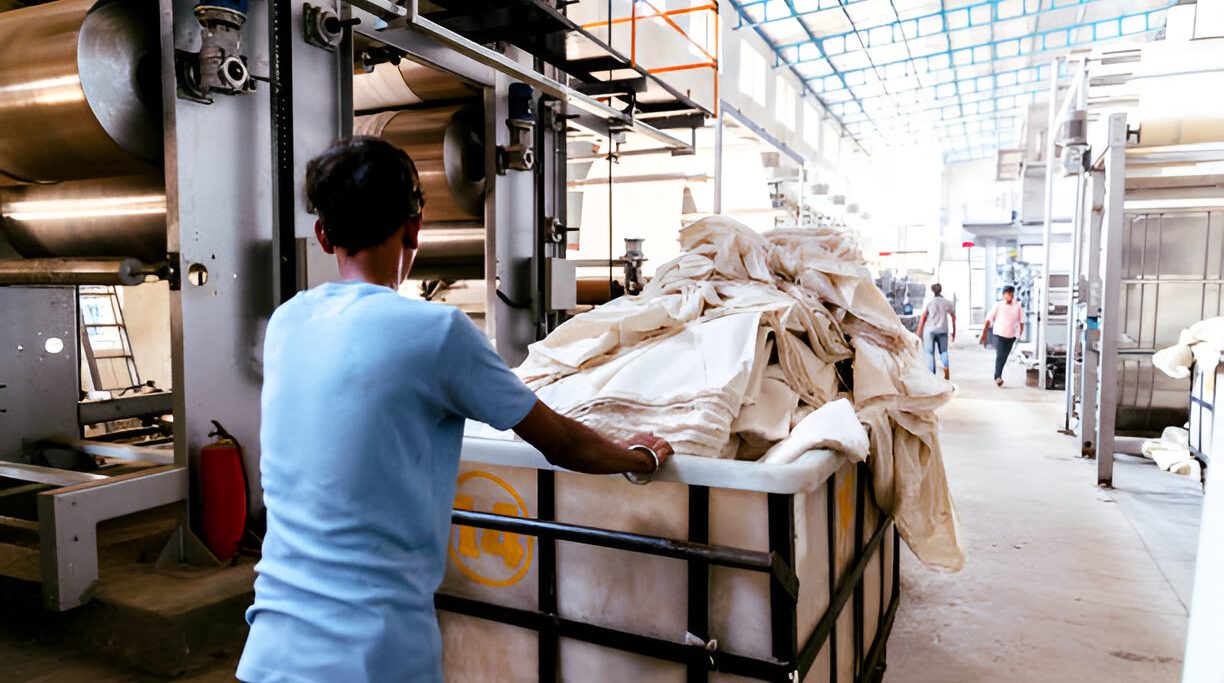
Behind the scenes, producing the “perfect” T-shirt remains a highly technical process. Raw cotton fibres are carefully carded and combed to achieve the right thread count. Dye-absorption testing ensures colour consistency across bulk runs. Fabric shrinkage is engineered out during pre-washing processes so the garment retains its “T” shape after every wash.
The T-Shirt: Over 100 Years of Hidden Engineering
The next time you pull a T-shirt off the hanger, you’re holding more than casual clothing. You’re holding over a century of industrial problem-solving — from factory workers improvising in the heat, to naval engineers designing for function, to Hollywood redefining fashion, to modern textile technicians perfecting every thread count and seam.
The “T” isn’t just a letter. It’s a blueprint. It’s a piece of industrial history. And it’s the reason the most ordinary item in your wardrobe is, quietly, one of the most brilliantly engineered.
Frequently Asked Questions
What does the “T” in T-shirt stand for?
The “T” refers to the shape of the garment when laid flat. With the sleeves extended horizontally, the silhouette of a T-shirt forms a capital letter “T” — giving it its name.
Who invented the T-shirt?
The modern T-shirt evolved from the “bachelor undershirt” introduced by the Cooper Underwear Company in 1904. The US Navy officially adopted it as standard issue in 1913, cementing its widespread use.
Who first used the word “T-shirt” in writing?
F. Scott Fitzgerald was the first to publish the word “T-shirt” in his 1920 novel This Side of Paradise.
Why did the T-shirt become popular as outerwear?
The T-shirt transitioned from underwear to outerwear largely due to Hollywood icons Marlon Brando and James Dean wearing them on screen in the 1950s, sparking massive public demand.
How has the T-shirt changed over time?
Originally made from lightweight 3-ounce fabric for use as an undergarment, T-shirts were re-engineered in the 1950s using heavier 5–6 ounce ringspun cotton with reinforced seams and ribbed necklines to function as durable outerwear.