
In custom apparel manufacturing, the success of a garment relies entirely on its technical execution. While fashion founders naturally focus on custom prints, fabrics, and GSM weight, factory production managers analyze a completely different variable: the armhole seam.
The way a sleeve is cut and attached to the bodice dictates the entire garment assembly line. It alters fabric consumption yields, sewing machine configuration, labor times, and ultimately, your final cost per unit.
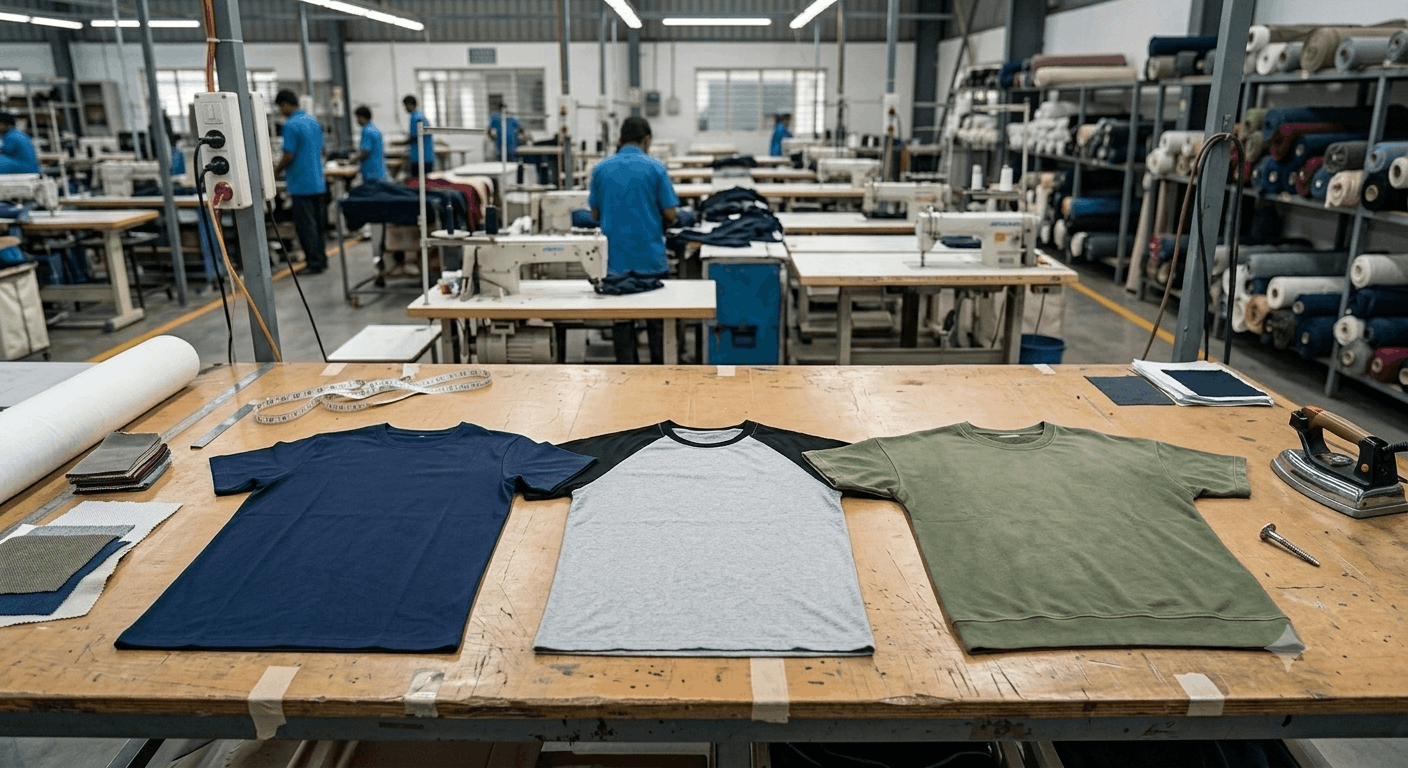
If your brand is moving past basic blanks and entering custom cut-and-sew production, you must understand the manufacturing realities of the three dominant T-shirt sleeve types: Set-In, Raglan, and Drop Shoulder.
1. The Set-In Sleeve: The Global Production Standard
The Set-In sleeve is the undisputed classic in apparel manufacturing.It features a vertical, slightly curved seam that circles cleanly around the natural peak of the shoulder, anchoring the sleeve directly into the armhole (armscye) of the main body panels.
       [Shoulder Seam]
             |
       +-----+-----+   <-- High Rounded Sleeve Cap
       |   |     | |
       |   |     | |
  [Bodice] |     | [Sleeve]
The Manufacturing Mechanics:
Pattern Cutting: The sleeve pattern is cut separately with a distinct, high, rounded top known as the sleeve cap. The front section of the cap is cut with a deeper curve than the back section to accommodate the natural forward rotation of human shoulders.
The Assembly Line: Operating a set-in line requires precise alignment. Most modern factories utilize a “flat” assembly method where the sleeve cap is stitched to the armhole before the side seams of the shirt are closed. Then, a single, continuous flatlock or overlock stitch run seals the underarm seam and the bodice side seam simultaneously.
Production Verdict: Extremely cost-effective for automated mass production. Fabric nesting layout is highly optimized, leaving minimal textile scrap waste.
2. The Raglan Sleeve: Engineered Functional Freedom
Popularized by athletic apparel and classic heritage sportswear, the Raglan sleevefeatures a continuous panel of fabric that extends all the way from the underarm diagonally up to the neckline.This eliminates the traditional shoulder seam entirely.
  [Neckline]
     \
      \  <-- Diagonal Seam
       \_____
       |     |
[Bodice]     [Raglan Sleeve Panel]
The Manufacturing Mechanics:
Pattern Cutting: The front and back body panels require deep, diagonal notches cut out from the armpit to the collar. The sleeve pattern itself is much larger, absorbing the entire shoulder surface area.
The Assembly Line: Raglan production changes the sequence of operations. Operators must first attach the diagonal sleeve panels to the front and back bodice panels using heavy-duty flatlock machines to ensure flat, abrasion-resistant seams for activewear. Only after the neck ring is established can the sides and underarms be sealed.
Production Verdict: Higher production cost. The irregular, elongated geometry of a raglan sleeve pattern reduces nesting efficiency on the cutting table, resulting in higher fabric consumption (higher wastage percentage per marker). However, it is the definitive choice if your brand prioritizes mobility or multi-color, athletic blocks.
3. The Drop Shoulder Sleeve: The King of Modern Streetwear
The Drop Shoulder sleeve is a deliberate structural alteration where the armhole seam is forced significantly wider than the natural shoulder blade, draping loosely onto the upper bicep.
   [Extended Bodice Panel]
             |
             +--------+
             |        | <-- Dropped Armhole Seam
             |        |
        [Bodice]      [Short, Wide Sleeve]
The Manufacturing Mechanics:
Pattern Cutting: The bodice panels (front and back) are cut as wide, oversized rectangles that spill over the shoulder tip.Consequently, the sleeve pattern itself is modified: the high, curved sleeve cap of a standard set-in sleeve is completely flattened and shortened into a wide, shallow trapezoid.
The Assembly Line: Because the armhole seam sits flat on a straight section of the extended bodice rather than curving around a structural joint, sewing a drop shoulder is incredibly fast and forgiving. There is no need to “ease” a curved cap into a tight armhole socket.
Production Verdict: Despite the fabric width requirements for the oversized torso, drop shoulder manufacturing reduces assembly labor times. It provides a heavy, structured silhouette perfect for heavyweight streetwear lines (280+ GSM) that need to hold a premium drape.
Summary Manufacturing Matrix
| Sleeve Type | Pattern Complexity | Cutting Waste | Sewing Assembly Difficulty | Best Application |
| Set-In | Medium (Requires precise front/back curves) | Low (High nesting efficiency) | Medium (Requires accurate cap alignment) | Retail fashion, standard streetwear, basic apparel blanks |
| Raglan | High (Diagonal curves) | High (Elongated pattern shapes) | High (Requires specialized flatlock sequences) | Sportswear, activewear, vintage color-blocking |
| Drop Shoulder | Low (Straight, flattened lines) | Medium | Low (Easiest seam run on flat surfaces) | Heavyweight premium streetwear, oversized boxy collections |
At Cotton Monk, we know that a premium T-shirt isn’t just defined by its fabric blend or print layout—it is engineered from the seams out. Whether you are aiming for the tailored, precise drape of a standard set-in shirt, the flexible mobility of an athletic raglan, or the bold, heavy silhouette of a streetwear drop shoulder, our facility is equipped with automated cutting lines and skilled operators to execute each layout down to the millimeter. Matching the right sleeve type to your collection’s design intent is how we help you scale your brand from a simple concept into a retail powerhouse.