
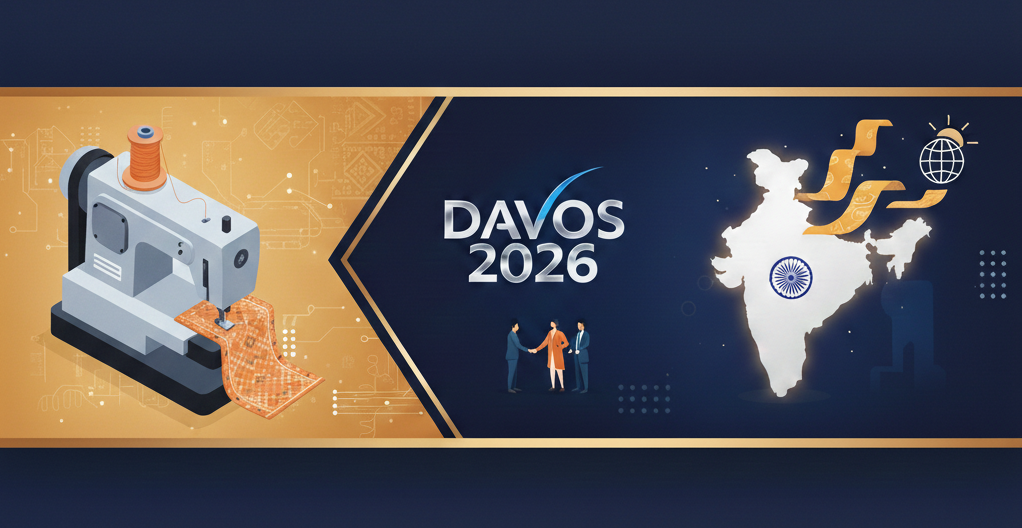
As the snow settles on the peaks of Davos this week, the conversations inside the glass-fronted pavilions of the World Economic Forum are set to change the very fabric of your daily life. While world leaders discuss geopolitical shifts, the Indian delegation has arrived with a vision that goes far beyond policy.
Davos 2026 isn’t just about finance; it is about a fundamental transformation in how your favorite shirt is born, designed, and delivered. The buzz in the Swiss Alps signals a new era for Indian Textiles—one that promises to bring world-class quality, AI-driven precision, and sustainable luxury straight to your wardrobe.
Here is why this global summit matters for the future of fashion in India and beyond.
1. The Rise of the Mega Park: Everything Under One Roof
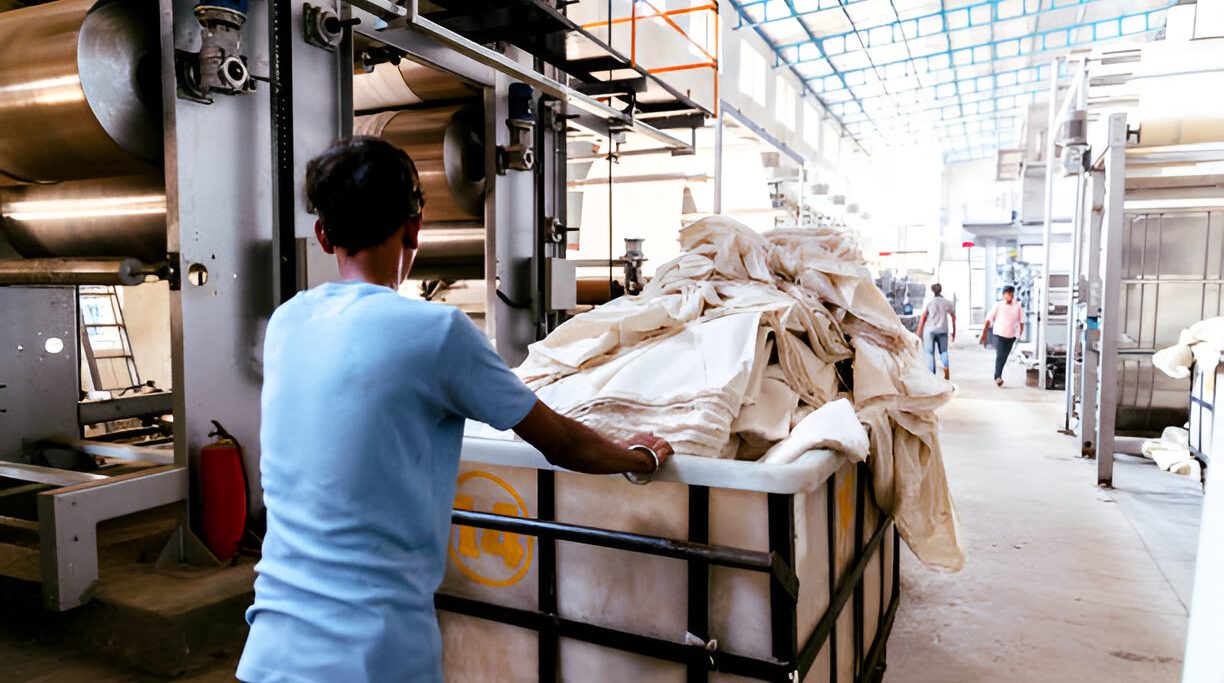
Traditionally, the “journey of a shirt” has been fragmented. A cotton ball might travel hundreds of miles to be spun, hundreds more to be dyed, and further still to be stitched. This adds cost, carbon footprints, and inefficiency.
The biggest talking point of Davos 2026 is the rapid operationalization of India’s PM MITRA Mega Textile Parks. These are not just industrial zones; they are integrated ecosystems.
-
Farm to Fashion: The spinner, weaver, dyer, and tailor work side-by-side.
-
Consistency: Integrated workflows mean unparalleled precision in fabric quality.
-
Affordability: By cutting out the “middle miles,” India is keeping high-quality fashion affordable despite rising global costs.
2. Where Tech Meets Thread: The Silicon Valley of Style
One of the most exciting pitches from the Indian corridors is the expansion of Global Capability Centers (GCCs). Once the domain of software giants, textile GCCs are becoming the “brain trusts” of the global fashion industry.
This is where the manufacturing “brawn” meets the digital “brains.”
-
AI Forecasting: Advanced algorithms are now predicting next season’s color trends before they hit the runway.
-
Digital Twins: Technology is being used to create “Digital Twins” of garments to ensure that a “Medium” fits you perfectly every time, regardless of the brand.
-
Smart Fashion: Design centers are moving closer to weaving hubs, slashing the time it takes for a trend to move from a sketch to your local store.
3. The Green Thread: A Future Woven in Ethics
Sustainability is the heartbeat of Davos this year. India, already the producer of over half the world’s organic cotton, is showcasing a future where textile parks operate on:
-
Renewable Energy: Solar and wind-powered production lines.
-
Zero Liquid Discharge (ZLD): Systems ensuring not a single drop of toxic dye water reaches rivers.
In 2026, buying “Made in India” means supporting a process that respects the earth, proving that ethical fashion doesn’t always need a luxury price tag.
4. The Reality Check: Giants vs. Artisans
While the road ahead is paved with gold thread, it is not without potholes. A significant topic of debate is the fate of India’s legendary decentralized sector.
For centuries, the magic of Indian textiles came from small-scale weavers in towns like Bhiwandi and Varanasi. There is a valid concern that as the industry consolidates into hyper-efficient Mega Parks, smaller players may struggle to compete on price and speed.
The Challenge for 2026: The true measure of success for Indian textiles won’t just be the scale of the Mega Parks, but how we weave millions of traditional artisans into this new narrative. The goal is to avoid trading unique regional character for standardized perfection. We must ensure the vibrant tapestry of Indian heritage doesn’t become a monotonous landscape of mass production.
5. A Tailor-Made Future
Ultimately, the goal of bringing these technologies to the global stage in Davos is consumer-centricity. By housing the design brains (GCCs) and manufacturing brawn (Mega Parks) in the same geography, India is building the world’s most responsive textile ecosystem.
The next time you slip into a garment that feels like a second skin, remember that its journey likely began with a 3D scan and a smart factory designed with you in mind. The mountain air in Switzerland may be cold, but the future of Indian fashion has never looked brighter.