
In the high-stakes world of global fashion, sustainability is no longer a luxury—it is a ticket to entry. While many industrial clusters talk about “green initiatives,” the city of Tiruppur in Tamil Nadu has achieved the impossible. As of 2026, Tiruppur stands as a global beacon of hope, recycling nearly 130 million liters of water every single day.
This is the story of how the “Knitwear Capital of India” turned an environmental catastrophe into a technological masterpiece known as Zero Liquid Discharge (ZLD).
Understanding Zero Liquid Discharge (ZLD) in 2026
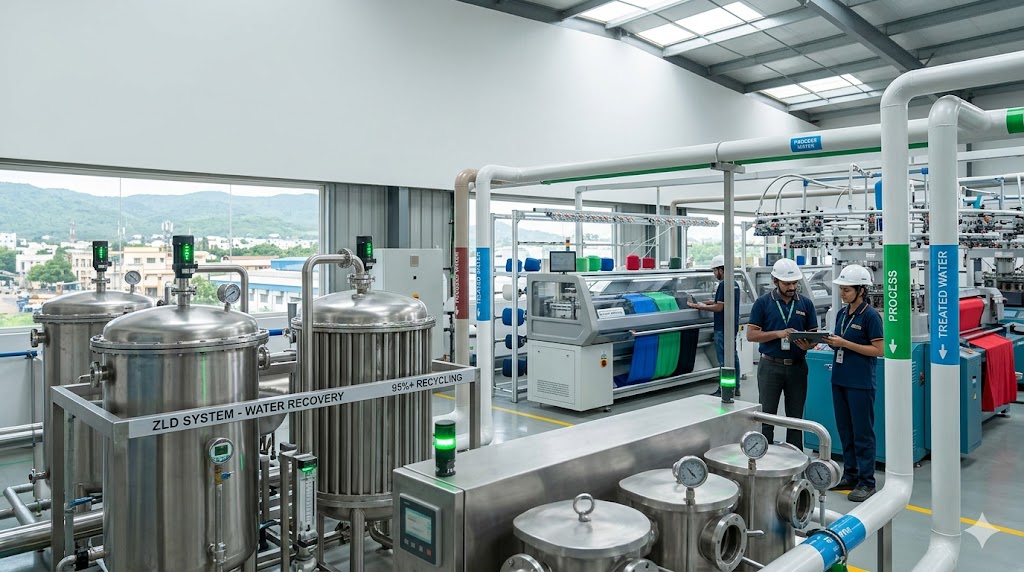
At its core, ZLD is an advanced wastewater treatment process that ensures not a single drop of industrial effluent is released into the environment. Instead of discharging treated water into rivers or sewers, the system purifies the water to such a high standard that it is piped back into the factories for reuse.
In Tiruppur, this process leaves behind only two things: crystal clear water for dyeing and solid salt crystals that are reused in the production cycle. It is the ultimate example of a Circular Economy.
The 2011 Crisis: The Death and Rebirth of an Industry
To understand Tiruppur’s evolution, we must look back at its darkest hour. By 2010, the Noyyal River—the lifeline of the region—had been severely impacted by untreated dyes and salts. In a landmark 2011 ruling, the Madras High Court ordered the immediate closure of over 700 dyeing units.
The industry faced a total wipeout. However, the entrepreneurs of Tiruppur didn’t give up. They collaborated with the government to invest over ₹1,000 Crore into building Common Effluent Treatment Plants (CETPs). This wasn’t just a repair job; it was a total reinvention of how textiles are made.
How the Modern ZLD System Functions
The technology powering Tiruppur in 2026 is world-class. The process follows a rigorous scientific path to ensure purity:
-
Biological Treatment: Specialized microorganisms break down organic contaminants in the wastewater.
-
Reverse Osmosis (RO): Advanced membrane technology separates the pure water from the dissolved salts and dyes. This “RO Permeate” is so pure it is actually better for dyeing than raw groundwater.
-
Evaporation and Crystallization: The remaining salty “reject” is sent to massive evaporators. The water is turned to steam and recovered, while the salt is crystallized into solid form.
-
Resource Recovery: In 2026, Tiruppur factories even recover the heat from these processes to generate power, further reducing their carbon footprint.
Why Global Brands Choose Tiruppur in 2026
For international buyers from the US and Europe, Tiruppur offers something most competitors cannot: Ethical Certainty.
With the 2026 updates to the Higg Index and ZDHC (Zero Discharge of Hazardous Chemicals) standards, brands like Nike, Patagonia, and Zara require proof of environmental compliance. Because Tiruppur operates on a 100% ZLD model, manufacturers here bypass the heavy “pollution taxes” seen in other manufacturing hubs.
By choosing Tiruppur, global brands are not just buying t-shirts; they are buying a “Green Guarantee” that resonates with the modern, eco-conscious consumer.
Frequently Asked Questions
What exactly is Zero Liquid Discharge (ZLD)?
ZLD is a treatment process that removes all liquid waste from a system. The goal is to produce clean water suitable for reuse and a solid residue that can be safely managed or recycled, ensuring no wastewater enters local ecosystems.
How much water does Tiruppur recycle daily?
As of 2026, the Tiruppur textile cluster recycles approximately 130 to 150 million liters of water per day (MLD). This massive recycling effort has significantly recharged the local water table and reduced the industry’s reliance on external water sources.
Is ZLD expensive for manufacturers?
Initially, the capital expenditure for ZLD is high. However, in the long run, Tiruppur exporters save money by recycling up to 95% of their water and recovering expensive salts. It also protects them from legal shutdowns and attracts premium global buyers willing to pay for sustainable products.
Does ZLD help with ESG (Environmental, Social, and Governance) scores?
Yes, ZLD is the gold standard for the “E” (Environmental) in ESG. Factories in Tiruppur frequently top the charts in global sustainability audits, making them the preferred partners for multinational corporations looking to clean up their supply chains.
Can the salts recovered from ZLD be reused?
Absolutely. Modern technology in Tiruppur allows for the fractional crystallization of salts. The recovered sodium chloride and sodium sulfate are high-quality enough to be used again in the dyeing process, completing the circular loop.
The Blueprint for the Future
Tiruppur’s evolution from a polluted town to a global leader in ZLD is a blueprint for every industrial hub in the world. It proves that with collective will and the right technology, we can have a thriving economy without sacrificing our rivers. In 2026, the “Tiruppur Model” is no longer just an Indian success story—it is the world’s standard for sustainable fashion.